Explaining Affirmative Action: Its merits and opposition

By Chikamso Chijioke
When you think of affirmative action, do you envision a less qualified minority applicant getting chosen over a qualified white candidate?
If so, you wouldn't be the only one. In light of numerous lawsuits over the years against colleges and universities alleging discrimination of some white and non-white applicants in favor of black and other people of color, the validity of affirmative action has been called into question. Many have called to dismantle it altogether. The problem is, many of its opponents don’t understand what it is and how it actually works. So, here is your guide to the truth about affirmative action.
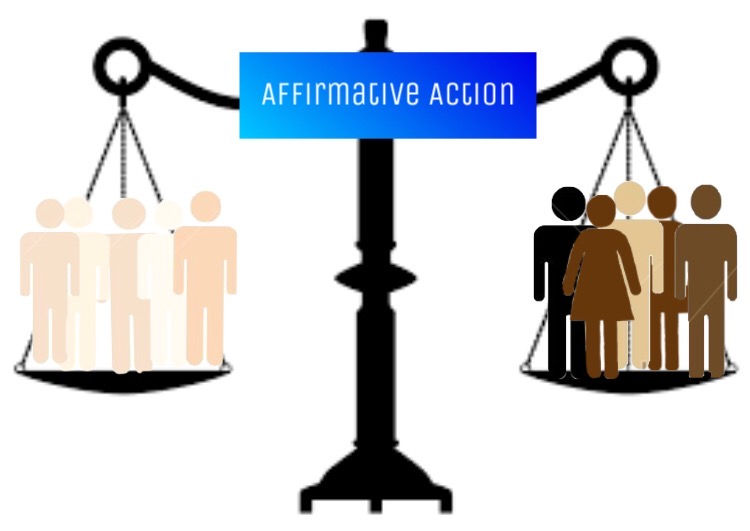
To begin, let’s take it all the way back to the origins of affirmative action. It was first implemented by President John F. Kennedy in 1961. JFK’s executive order 10925 required federal contractors to "affirmative action to ensure that applicants are treated equally without regard to race, color, religion, sex, or national origin." His successor Lyndon B. Johnson expanded on affirmative action with executive order 11246 in 1965, and again in 1967 to include women. It was created to level the playing field by actively making efforts to provide opportunities for minorities and women.
It is important to acknowledge the false assumptions about affirmative action. Many believe it is some sort of quota system of universities trying to get X amount of black people, so they choose a black student with low test scores and GPA over a white student with perfect scores. That is simply not the case. The U.S Supreme court case of Regents of the University of California v. Bakke in 1978 made quotas in admissions unlawful, but allowed race to be a factor, so long as it was not the only factor. We must also remember that there is more to college applications than test scores or grades. Holistic review incorporates a slew of factors about an applicant to determine their acceptance or rejection from the academic institution. Affirmative action is not meant to select unqualified applicants over qualified ones. If it happens to do so, it is illegal under Title VII of the Civil Rights Act.
The notion that affirmative action lead to discrimination against white men and women is not supported by data. White women have historically been the biggest beneficiaries of affirmative action. They have seen the most advancement in education and employment- more so than other women of color- that would not have occurred if not for affirmative action. As for the discrimination of white men, it is essentially nonexistent. There were 91,000 employment discrimination cases reported to the Equal Employment Opportunity Commission, only around 3% of them were against white men. In fact, a study done by Rutgers University and funded by the U.S. Department of Labor in 1995 concluded that discrimination against white men was not an apparent issue, since many of the claims brought forth by white men did not have warrant. Even when white people condemn affirmative action as a defense for Asian American students, it is often an attempt veiled as concern for the students’ lost opportunities at the hands of “unqualified” black students. In reality, it is an application of the model minority myth, which has long been used to pit Asians and other minorities (especially African Americans) against each other. A perfect example is the infamous lawsuit against Harvard in 2014, where the Students for Fair Admissions accused the school of holding Asian students to a higher standard than other minorities during the application process, therefore lowering their chances of acceptance. What is very interesting about that suit is not only that the number of Asian students in Harvard is proportional to those who apply, but additionally it was brought forth by Edward Blum, a conseravtive activist who pursued the same tactic in 2013. In Texas v. Fisher, he and Abigail Fisher argued that she did not get into University of Texas Austin because she was white. In truth, she was not admitted because she was not in the top 10% of her graduating Texas High School class (which would have guaranteed her a spot at UT Austin), and she did not excel at her holistic application review. So what I am trying to say is how legitimate is Edward Blum’s concern for Asain students regarding the Harvard suit? Was his intent to push for racial equality? Or was it to push a false agenda of reverse racism, while ignoring the underrepresentation of minorities in universities.
Regardless of your perception of affirmative action, it is abundantly clear that since its creation, it has reaped a bounty of benefits. It has been effective in making the educational and corporate spaces more accessible and diverse. And it is shown that diversity is good for everyone involved. The Century Foundation collected data that found that racially diverse schools yield a number of academic, economic, civic, and social emotional benefits. It does things like reducing racial bias, improving academic excellence, leadership, creativity, and problem solving skills. As well as increasing likelihood of high school graduation, college acceptance, and economic mobility. Affirmative action does not mean qualified people will miss out. It is not just diversity for the sake of it. It is an effective way to ensure that disenfranchised groups have the same opportunities that historically, have only been given to a select few.
Sources:
Comments